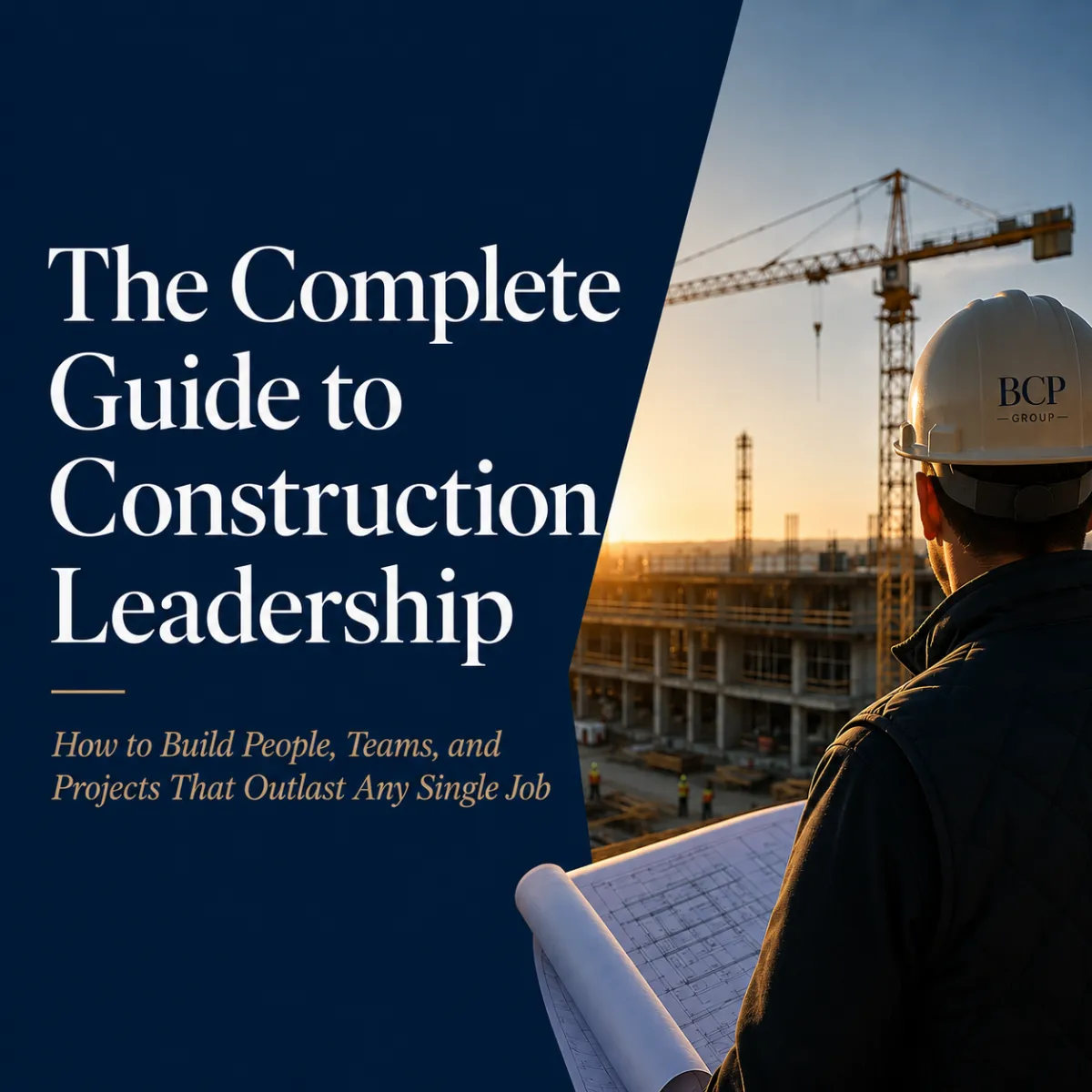
The Complete Guide to Construction Leadership
It is 6:45 a.m., and the lot is still mostly dark. The lights in the trailer come on. Coffee gets started. The first superintendent walks in. We talk about yesterday's pour, the inspection that got pushed, and what the day actually looks like from here.
Nobody is taking notes for posterity. Nobody is here to be impressed. We are here to do the work.
That is where construction leadership lives. Not in the keynote or the case study. In the morning huddle. In the second cup of coffee. In the phone call you make at 4 p.m. to give a subcontractor the heads-up their crew needs before they pack up.
Great projects are built in the moments nobody notices. Stack enough of those quiet, unglamorous days back to back, and the end result takes care of itself.
This is the complete guide to construction leadership. Twenty-five years on critical projects and over a billion dollars of work put in place taught me one thing more than anything else. The schedule does not lead the project. The drawings do not lead the project. The contract does not lead the project. The people lead the project. And someone has to lead the people.
This guide is for the construction professional who has the title and is figuring out the job. Project managers, superintendents, owner's reps, directors, anyone who carries the responsibility for the work and the team doing it. It is the framework I wish someone had handed me when I was twenty-five and trying to figure out why the technical skills that got me promoted were no longer enough.
Construction leadership is not a personality. It is not charisma. It is not the loudest voice in the trailer. It is a daily operating system built on four pillars.
Trust comes first because nothing else works without it. Teams come second because no project gets built by one person. Partnerships come third because the best work happens when everyone at the table shares a mission. Legacy comes last because the building is not the goal. The people, the standards, and the careers you develop along the way are the goal.
What Construction Leadership Actually Is
Construction leadership is the daily work of building people, projects, and partnerships in an industry where the stakes are real and the margins are thin. It is not the same job as construction management.
Construction management is the technical discipline. You schedule the work, manage the contract, control the cost, track the quality, and deliver the building. The drawings are the deliverable. The schedule is the deliverable. The certificate of occupancy is the deliverable.
Construction leadership is what makes all of that possible. It is the work of building the team that delivers the project, earning the trust that keeps the partnership intact through every change order and every hard conversation, and developing the next leader on your team so that one day they lead a project of their own.
These two jobs sit on the same person, and they do not feel the same. Most of us start in the technical work. We learn how a project actually goes together. We earn the title because we are good at the technical work. And then the title arrives and the job changes underneath us.
The new job is not measured by what we personally produce. It is measured by what our team produces. It is not solved by working harder in the same direction. It is solved by working differently. The skills that got you here will not lead you from here. That is not a problem. That is the design.
Construction leadership skills are not a separate set of personality traits. They are a set of daily practices that anyone can build, and they sit on top of the technical fluency you already earned. They include how you set the tone in the morning huddle, how you respond when a subcontractor brings you a problem, how you talk about your team when they are not in the room, how you give feedback, and how you handle the days when the project is not going well.
Every one of those practices belongs to one of the four pillars. Trust. Teams. Partnerships. Legacy.
The four pillars are the operating system. They are not a sequence to complete. They are not a checklist. They are four lenses on the same daily work. On a good morning, you are touching all four before lunch.
When you build the habit of running every decision through the four pillars, the right answer almost always becomes clear. When you do not, the noise of the day pulls you toward whatever is loudest. The pillars are how you stay grounded when the project is moving fast.
Let us walk through each one.
Build Trust: The Currency of Every Job Site
Trust is the only currency that matters on a job site. It is the only thing that compounds across a twenty-five-year career. You can lose a project and rebuild. You cannot lose your trust and rebuild it on the same job. Once it is gone, it is gone. The next job is where you get to start over.
Every person you work with keeps an invisible ledger. The general contractor keeps one on you. The owner's rep keeps one. The trades keep one. Your own team keeps one. The ledger does not care about your intentions or your job title. It tracks one thing. Do you do what you say you are going to do.
The good news is that the ledger is easy to build. You do not need a grand gesture. You need a hundred small consistent ones. You said you would have an answer by Thursday. The answer arrives by Thursday. You said you would walk the punch list with the super on Tuesday morning. You are walking it Tuesday morning, on time, in your boots. You said the change order would be in by end of day. It is in by end of day.
The first pillar is built one promise at a time. The promise can be small. The promise has to be kept.
The second piece of building trust is spending other people's money like it is yours. The owner is writing checks for work they cannot personally inspect. The trades are betting that you will pay them on time. The subcontractors are betting that you will protect their margin through the change order process. When you treat their money the way you would treat your own, everyone in the room notices, and your ledger goes up.
The third piece is bringing the bad news early. Bad news is going to happen. Bad news is part of every project. The leader who brings the bad news the moment they have it, with two or three thoughtful options for how to respond, becomes the person the room learns to count on. The leader who waits to be asked is no longer leading.
Trust is also the foundation underneath every other pillar. You cannot build a team that does not trust you. You cannot build a partnership without trust on both sides of the table. You cannot leave a legacy of leaders behind you if they were never able to trust you in the room.
This is why trust comes first in the four pillars. The order is not arbitrary. The order reflects what has to be true before anything else works.
Build Teams: People Who Lead Without You in the Room
The best construction leaders develop people who can run the project without them.
This sounds easy. It is not. It runs against the instinct that got most of us promoted in the first place. The instinct to be the most capable person in the room. The instinct to grab the problem and solve it personally. The instinct to be the hero.
The hero instinct served you on the way up. It is what got you noticed. It is what convinced your director that you could handle more responsibility. And then you got the responsibility, and the instinct started working against you.
Leading construction teams is not the same as being the best individual contributor. The job is to build people who can hold a standard you set, in a room you are not in. That requires a different muscle.
The first practice is the daily huddle. Not a status meeting. Not a stand-up by another name. A ten-minute, structured conversation at the start of the day where the team aligns on the work, the obstacles, and the wins. The huddle is the most underrated leadership tool in this industry, and it is the one habit I would put in every PM's calendar without exception.
The huddle does three things at once. It transfers information. It builds the team. It develops the next leader, because over time you let your team members run the huddle while you sit in the corner and listen.
The second practice is accountability without blame. When something goes wrong on a project, the lazy version of leadership looks for the person to point at. The honest version asks what in the system allowed this to happen, and what we are going to change so that it does not happen again. The team you build under the second version of accountability will run through walls for you. They surface problems early because they trust the response, which is exactly the team you want on every project.
The third practice is knowing the difference between rockstars and team players. Rockstars produce. Team players elevate the people around them. Most of us instinctively reward the rockstar because the results are visible and immediate. The team player's contribution is harder to see and slower to compound. But it is the team player who builds the next generation, and it is the team player you should be promoting.
The fourth practice is creating what I call the sacred space. The conversation in your office, with the door closed, that no one outside the room ever hears about. That is where you develop people. That is where you give the feedback that actually changes behavior. That is where you tell someone you believe in them and you mean it. The sacred space is one of the most powerful tools a leader has, and it costs nothing except your willingness to be present.
When the team is built right, you walk onto the project and the work is already moving. The huddle is happening without you. The problems are getting solved without you. Your job is no longer to be the most capable person in the room. Your job is to make sure the room is full of capable people. That is leading construction teams.
Build Partnerships: Make Their Mission Your Mission
The third pillar is partnerships, and it is the one that takes the longest to learn.
A partnership in construction is not a contract. It is a working relationship where both sides of the table have decided to make each other successful. Contracts are the floor of the relationship. Partnerships are the ceiling.
The instinct on a project is to protect your side of the table. The owner's rep protects the owner. The general contractor protects the GC. The subcontractor protects the sub. That instinct is not wrong. Everyone has a fiduciary responsibility. The mistake is when protecting your side becomes the only thing you are doing.
Construction project leadership at the partnership level requires a different frame. Your job is not just to deliver your scope. Your job is to make their mission your mission. You take the time to understand what success looks like for them. The owner cares about cost certainty and schedule certainty because they have boards and budgets and patients and tenants depending on them. The trades care about predictable cash flow and protected margins because they have their own families and crews depending on them. When you understand what matters to the person across the table, you can make decisions that serve both sides instead of just yours.
This is the work of stakeholder mapping. On every project, before the first shovel hits the ground, the smart leader maps every stakeholder, internal and external, and asks one question about each. What does success look like for this person. The answers go in a document you actually update. They drive the way you communicate. They drive the way you negotiate. They drive the way you handle the inevitable surprises.
Partnerships built this way outlast the project. The owner who gets cost certainty and clear communication on one project hires you on the next one. The subcontractor who knows you will fight for their change order through legitimate channels brings their best crew to your next job. The owner's rep who saw you handle a tough conversation with grace puts you on the shortlist for the next program.
Every project is a chance to deposit into the partnership account. The deposits compound. Five years in, you are getting calls because of work you did before. Ten years in, the calls are the engine of the business. Twenty-five years in, the partnerships are the career.
The four pillars feed into each other. Trust makes the partnership possible. The team makes it deliverable. The partnership makes it repeatable. The repeatable work is what builds the legacy.
Which brings us to the fourth pillar.
Build Legacy: What Outlasts the Project
There is a moment in a construction career when success stops being enough. You have done the work. You have built the buildings. You have hit the numbers. And one morning you wake up and ask whether any of it actually mattered.
This is the shift from first half to second half. The first half of a construction career is about success. Earning the title. Earning the responsibility. Earning the respect. The second half is about significance. What you build on top of the success.
The first half is about you. The second half is about the people you develop.
The buildings you work on will eventually be renovated past recognition or torn down for the next generation. The hospital you spent three years on will get rebuilt by someone else's team in twenty years. The corporate campus you ran will be repurposed. That is the nature of the work, and there is no point being precious about it.
The people you developed will outlast every structure you ever built. The project manager you mentored who is now running their own team. The superintendent who started under you and is now training the next generation. The young engineer who watched how you handled the tough call and is doing it the same way ten years later. That is the legacy.
Construction management leadership at the legacy level is about choosing what to invest in. Stephen Covey calls them the big rocks. The big rocks are the few decisions in any season of life that actually matter. Your faith. Your family. Your health. The people you develop. The standards you hold. Everything else is sand, and the sand will fill the spaces around the big rocks if you put the rocks in first. But if you fill the jar with sand, the big rocks never fit.
Most of us in this industry are good at filling the jar with sand. The email. The meeting that did not need to happen. The decision that should have been delegated. The legacy leader is the one who has the discipline to put the big rocks in first, every week, and let the sand find the spaces around them.
The fourth pillar also includes the standards you set. The way your team runs a huddle ten years after you leave the company. The way the trades on your projects expect to be treated, because that became the norm under your leadership. The way the next generation of owner's reps in this industry think about partnership, because they learned it on a job site you ran.
Legacy is not a retirement project. Legacy is built every day, in the same daily practices that build the other three pillars. The difference is that you are no longer building the legacy for yourself. You are building it for the people who come behind you.
How the Four Pillars Compound Over a Career
The four pillars are not a sequence to complete. They are a daily operating system that compounds over decades.
Here is how the compounding works.
Year one in your first leadership role, you are building trust one promise at a time. You are learning the daily huddle. You are figuring out who on your team is a rockstar and who is a team player. You are spending most of your time on the first two pillars because that is what the role demands.
Year five, the trust you built in year one is paying interest. The owner who watched you handle the change order honestly is putting you on their next program. The two project managers you developed under you are now leading their own jobs and bringing you with them as the senior leader. Partnerships are starting to compound.
Year ten, the team you built is building its own teams. The people you mentored are now mentoring others. The huddle you taught your first PM is happening on three projects in two states. You are still doing the daily work, but the daily work has multiplied.
Year twenty, the partnerships you invested in are the engine of the business. The work comes in because of who you are, not because of what you sell. Your calendar is full of conversations with people you trust and who trust you back. The career, at this point, is largely self-organizing.
Year twenty-five, you start asking the second-half questions. You look at the leaders coming behind you and you start investing differently. You take the call you would not have taken at year ten. You write the book or build the training program or take the consulting role that lets you develop the next generation at scale.
The compounding does not happen because you wake up one day and decide to be a great leader. It happens because of the small choices you made every day for twenty-five years. The morning huddle you did not skip. The promise you kept. The hard conversation you did not avoid. The credit you gave to someone else. The big rock you protected when the sand was screaming for attention.
Construction leadership compounds the same way every other long-term skill compounds. Slowly, then suddenly. The first five years feel like they are taking forever. Year fifteen feels like it happened in a weekend.
The work is daily. The reward is generational.
Where to Start
The four pillars are the operating system for a career, not a quarter. Trust. Teams. Partnerships. Legacy. Run every decision through them. Build the habit of asking which pillar the next ten minutes is serving. Stack enough of those days back to back, and the career builds itself.
If this framework lands for you and you want the deeper version, that is what Building People Who Build Hospitals is. The book takes each of the four pillars and walks them out across twenty-five years of stories, frameworks, and practical tools you can use the next morning. It is the leadership book I wish someone had handed me when I was a young project engineer trying to figure out why the technical answers were no longer enough.
If you are leading a team and you want the four pillars built into ongoing coaching and development, that is Building People Academy. The Academy turns the framework into structured training that fits the way your team actually works.
Start where it makes sense for you. Just start.