BCP Critical Solutions • Senior Advisory Practice
A steady hand
on the projects that matter most.
BCP Critical Solutions advises owners, executives, and facilities leaders on complex construction projects. Twenty-five years of experience, both sides of the table.
Owner’s Representation
Program & Project Oversight
Critical Shutdown Planning
one practice · three ways to engage
A consulting practice built on one idea, delivered three ways.
BCP Critical Solutions is a senior advisory practice for complex construction projects. Three offerings, one discipline: experienced counsel that represents the owner's interests, brings independent oversight to the work in motion, and carries the project through its most
consequential moments.
Healthcare construction is the proving ground. The methods were built and stress-tested across major healthcare facilities, the most operationally demanding environment in the industry. The practice serves complex construction projects broadly.
01
Owner's Representation
02
Program & Project Oversight
03
Critical Shutdown Planning
01 · service area
Owner's Representation
Your seat at the table, occupied by someone who
has done this before.
Owner's representation is the most personal engagement in the practice. Michael steps into the owner's seat from concept through closeout, carries the owner's interests in every meeting, and makes sure the people in the room are working toward the outcome the owner is paying for.
Owners bring in BCP for the same reason they bring in any senior advisor: someone with the experience to ask the right question in the moment it matters, the standing to push back when something is off, and the patience to walk a complex project from kickoff to the punch list.
what the engagement covers
Contract review and negotiation support
Design and constructability review
Schedule, budget, and pay application oversight
Stakeholder coordination across design, construction, and operations
Change order, claim, and dispute negotiation
Executive and board-level reporting
02 · service area
Program and Project Oversight
Independent review that catches what an in-house
team is too close to see.
Program and project oversight is the senior eye on work already in motion. Michael partners with internal teams, owner's representatives, and program managers to verify that contractor plans hold up, schedules tell the truth, and standards are being met across every project in a program.
This is the engagement for organizations that have capable people running their projects and want a senior outside perspective to keep things on the rails. The work is collaborative, not adversarial. The deliverable is confidence at the executive level that the program is doing what leadership thinks it is doing.
what the engagement covers
Independent review of contractor plans, schedules, and submittals
Active oversight on individual projects and across full programs
Quality and standards verification on the ground
Early identification of schedule, budget, and risk exposure
Coaching and support for in-house project teams
Executive and board-level program reporting
03 · service area • specialty practice
Critical Shutdown Planning and Execution
The most demanding work in construction,
delivered as a quiet, planned event.
Critical shutdowns are construction events performed inside operating facilities where the surrounding building cannot tolerate interruption. The job of a senior partner is to replace assumption with verification, write the plan the team can follow, and stand with the crew while the work is happening.
This is the deepest part of the practice. The methodology was built across twenty-five years of healthcare construction, the most demanding occupied-facility environment in the industry. The same methodology applies to any complex shutdown where the building stays open and the work needs to be invisible to the people who depend on it.
what the engagement covers
Forensic audit of existing conditions and documentation
Method of Procedure development, review, and sequencing
Coordination between construction teams and facility operations
On-site command and control during the shutdown event
Back-out planning and contingency design
Post-event debrief and standards documentation
"A perfectly boring shutdown is not an accident. It is the result of exhaustive preparation."
The methodology is proven across major healthcare facilities. The same discipline applies to data centers, laboratories, manufacturing, and any complex occupied environment where the work has to be invisible.
how we work
How an engagement begins.
01
Understand
The first conversation is a conversation, not a pitch. Michael listens to the project, the people, the politics, and the outcome the owner is trying to reach. Both sides leave with a shared, honest picture of where things stand.
02
Align
Scope is built around what the engagement actually needs. Deliverables, decision rights, communication cadence, and the people in the room are agreed in writing before the work begins. Both sides know what success looks like.
03
Deliver
The work begins. Michael shows up, asks the questions that need asking, writes the plan, and stays accountable to the people who hired him. Engagements end when the agreed outcome is delivered, not when a retainer runs out.
about the advisor
Twenty-five years on
both sides of the table.
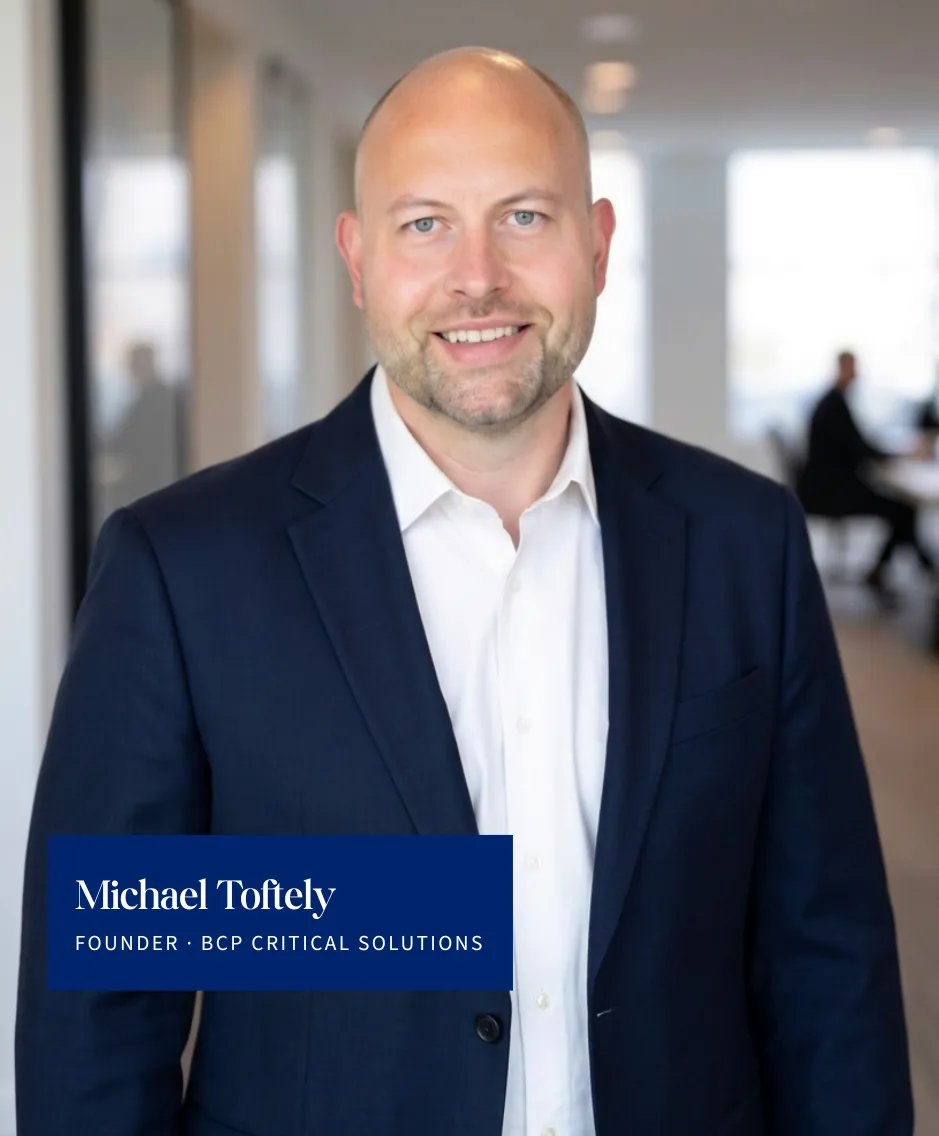
Michael has spent twenty-five years in construction, working both the contractor side and the owner’s representative side of the table. Healthcare construction was the proving ground: the most operationally demanding environment in the industry, where the surrounding building never stops working and the bar for getting it right is set by the people on the other side of the wall.
The practice he built is rooted in that dual perspective. Michael has stood in the contractor’s role and the owner’s role, written the plan and signed off on it, run the project and reviewed the project. That experience shows up in how the work is done: practical, patient, and grounded in the reality of how complex projects actually behave.
Experience
Twenty-five Years
In construction, across the contractor and owner's representative sides of the table.
perspective
Both sides of the table
Direct operating experience as a general contractor and as an owner's representative on the same kinds of projects.
proving ground
Major healthcare facilities
Career built across the most operationally demanding occupied environment in construction.
who this practice serves
Decision makers who carry responsibility for project outcomes.
The people whose name is on the project, and the people who answer to them. If you carry the weight of getting a complex project right, this practice is built for the seat you sit in.
01
Owners and developers
Leaders of complex capital projects. The people whose name is on the project and whose reputation rides on it.
02
Executives and board members
CEOs, COOs, and board chairs accountable for delivery. People who need confidence the project is on track and a partner who will tell them the truth either way.
03
Facilities directors and chief engineers
The people responsible for the building and the operations inside it. Often managing capital work on top of the day job.
04
Owner's representatives and program leads
In-house teams who want senior outside backup on the toughest
engagements, or independent review on programs they are running.
FROM THE PEOPLE WE SERVE
In their words.
book a call
Start with a
conversation.
Tell Michael about the project, the people involved, and the
outcome you want. The first conversation is a conversation,
not a sales call. Thirty minutes, no obligation, both sides leave
with a clearer picture.
frequently asked
Practical questions. Direct answers.
The questions that come up most often in first conversations. If yours is not listed here, send it along with your booking request.
Is a consultant an independent contractor?
Generally, yes. A consultant who isn't a W-2 employee of the company they're advising is typically classified as an independent contractor for tax and legal purposes. The specifics depend on how the engagement is structured, so it's worth confirming with a tax or legal professional for your specific situation.
What are the key factors to consider when planning healthcare construction projects?
That's a broad question, because the real answer depends heavily on your specific program, facility type, and stage. In general terms: clinical workflow and continuity of care during construction, regulatory review from multiple agencies, realistic costs for MEP and life-safety systems, a contractor's real preconstruction estimate rather than a third-party database number, and stakeholder alignment on the actual problem you're solving before design starts. That last one is the most overlooked, and it's exactly what our free program readiness assessment is built to surface before you're deep into a program.
How do government contracts influence construction consulting services?
Government and public health system contracts add layers of compliance, prevailing wage requirements, public bid law, additional reporting and documentation, that a private commercial project doesn't carry. That adds cost and time, and it means the owner's side needs someone who understands those requirements well enough to protect the project rather than just react to them.
How long does commercial construction take?
Timelines vary by project size, complexity, and delivery method. A smaller build-out or refresh might run a few months, while a major hospital campus project typically runs three to five years from planning through activation, and major programs can run a decade. Healthcare projects run longer than standard commercial work because of regulatory review, permitting, and phasing around occupied space.
What industries do you serve?
We specialize exclusively in healthcare construction: hospitals, medical office buildings, surgery centers, central utility plants, and other facilities where the work happens around active patient care. That focus is deliberate: healthcare construction has regulatory, workflow, and risk demands that general commercial experience doesn't prepare you for.
When should I start my healthcare construction project?
As early as possible. The decisions that determine a project's outcome get made long before the first wall goes up, and bringing the right people in early is the single highest-leverage thing an owner can do. If you're even a few years out, that's still the right time. Take our free program readiness assessment to see exactly where you stand today and what to focus on next.
How much does construction cost?
Construction costs vary enormously by project type and market, and general guides are often 30 to 70 percent below what real healthcare projects actually cost. Rather than give a misleading number here, see our full breakdown of real project cost data by category on our blog.
Do you offer design-build services?
We don't operate as a design-build entity ourselves. As Owner's Representative, we help clients evaluate delivery methods, including design-build, CM at Risk, and traditional AIA contract delivery methods, and choose the one that fits their project and risk tolerance.
What is design-build?
Design-build is a delivery method where one entity holds both the design and construction contracts, rather than the owner holding separate agreements with an architect and a contractor. It shifts most of the risk from the owner to the design-build team, since that one party is accountable for both the design and the price, and it compresses the schedule as a result. Worth understanding both sides of that trade before you choose it.
How do you manage project timelines?
The general contractor is responsible for the critical path schedule, with float and every owner line item represented, and for managing progress against that baseline every month as part of the pay application process. My role is to stay in that rhythm alongside them: regular schedule meetings with the GC and superintendent, especially when activities are shifting or falling behind, so problems get caught and corrected before they compound. The goal is always to maintain or beat the baseline schedule.
BUILDING CONSTRUCTION PEOPLE
Helping construction professionals build the careers, teams, and partnerships that last.


Copyright 2026. Building Construction People Group. All Rights Reserved.