
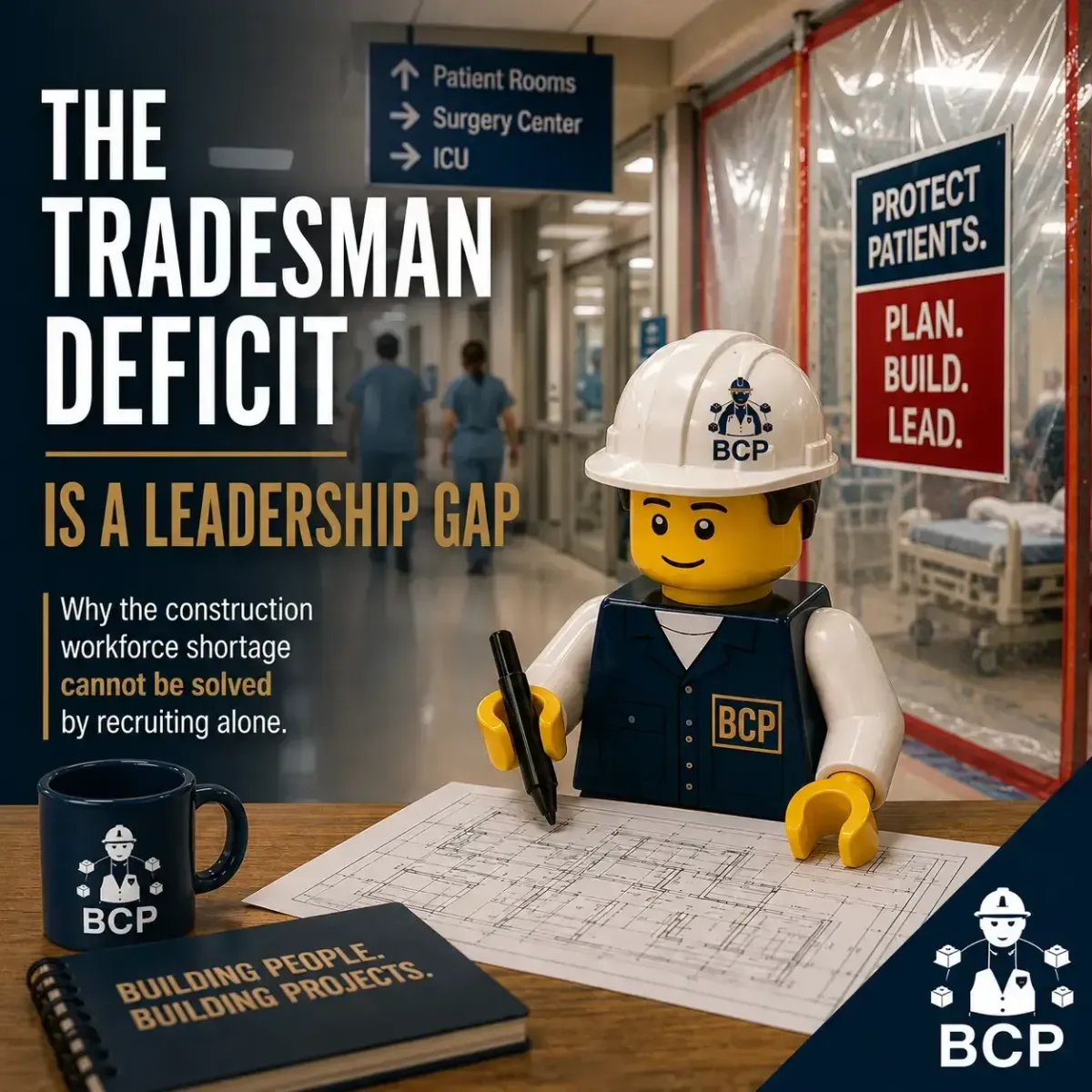
The Tradesman Deficit Is a Leadership Gap | BCP
Why the Construction Workforce Shortage Cannot Be Solved by Recruiting Alone
The construction industry needed 439,000 new workers in 2025 alone. 1.9 million over the next decade. Ninety-two percent of contractors already report difficulty filling open positions.
The conversation about this shortage is having a moment. Mike Rowe has been raising the alarm on the skilled trades gap for over a decade through his foundation and public advocacy. Now the rest of the industry is catching up. Last week Alison Satt at Swinerton wrote about it. A viral piece has been circulating about how BlackRock, Ford, Google, and Carhartt have started aligning on the skilled trades crisis. Every industry association is publishing white papers.
Most of the conversation is about recruiting. How do we attract more young people into the trades? How do we make construction visible again as a career?
Those are the right questions. But recruiting is not the answer. The answer is what happens after someone walks through the door.
The tradesman deficit is a leadership gap. And it gets closed one construction leader at a time.
Here is what I mean.
The Ceiling Isn't Real. The Door Is.
I've argued that construction has no ceiling (you can read that here). You can enter through any door. Laborer, apprentice, trade, field engineer, or assistant PM. All of them lead to programs to run, divisions to lead, and companies to own. The path never decides the ceiling.
That argument is still true. Every part of it is provable. I have watched it play out for twenty-five years.
But it invites a fair question. If the ceiling is not real, why aren't more people walking through the door?
The answer is not that the ceiling has come back. The answer is that the industry has spent decades installing barriers in front of the door and then wondering why the room is empty.
The biggest barrier is a credential filter.
Character Over Credentials
When I was Director of Construction responsible for interviewing and hiring young professionals to run programs worth hundreds of millions of dollars, I was hiring for the same things every time. Attitude. Work ethic. Coachability. The ability to earn trust. The willingness to name a problem before it grew. The character to show up every day for the people around them.
I was not hiring for the alphabet soup after the name.
A PMP certification attached to someone with poor attitude and no ability to earn trust is expensive wallpaper. It decorates the surface while the foundation crumbles underneath. Meanwhile, a young trades worker with the right character will out-perform a credentialed candidate every time on the things that matter to a construction program.
The university I worked for had a policy that they would only consider applicants with four-year degrees. We were shooting ourselves in the foot. Good candidates with strong job site experience and the right character were getting filtered out before they ever reached the interview table. Meanwhile some candidates with the degree but no work ethic were making it through the filter.
I worked with the vice president of our department to get that policy changed. It took time and persistence, but the argument was straightforward. We were missing great people. The best predictor of success on our team was not where someone went to school. It was whether they showed up with the right attitude, the willingness to learn, and the character to earn trust.
Those traits do not require a diploma.
The construction industry needs to have that conversation at scale. Not because credentials do not matter. They do, for certain roles. But because the credential filter, as currently applied, is keeping talented people out of the room who would out-perform the degree holders sitting inside it.
The Trades Are a Launching Pad, Not a Fallback
The other quiet barrier is a cultural story the industry has told for decades. It goes like this: professional construction management is a career. The trades are a job.
That story is false. And it is doing real damage.
Some of the best construction executives I have worked with came up through the trades. They started as a carpenter or an electrician. They became a foreman. They moved into a superintendent role. They eventually led divisions or founded their own firms. Their education was the job site itself, and the depth of their practical knowledge gave them an advantage that no classroom could replicate.
The industry needs to stop treating the trades as the fallback for young people who did not pursue a degree. The trades are one of the best launching pads into construction leadership that has ever existed. Companies that make that path visible and real will attract young people the recruiting brochures cannot.
Here is what I would like to see more companies do:
On day one, tell every young trades worker on the crew that the door to management is open if they want it. Not as a vague future possibility. As a real path with a real timeline. Then invest in the ones who show the character to take it.
Get rid of internal policies that require four-year degrees for management roles that could be filled by proven trades workers with high judgment. Test judgment differently. Test it through work. Through observed behavior. Through the demonstrated ability to run a crew, hold a schedule, and earn the trust of the people around them.
That is a policy change that opens the door to a whole generation the industry has been filtering out.
The Leadership Move
The tradesman deficit is not going to be solved by an industry-wide campaign. It is going to be solved one construction leader at a time, when each of us commits to three things.
Look at your current hiring filters and ask who you are screening out. If a young person with strong character and real job site experience cannot get through your process because they do not have a bachelor's degree, the filter is the problem, not the candidate.
Look at the trades workers already on your projects. Which ones have the character to grow into leadership? Tell them so. Not as a compliment. As a plan.
Invest in them the way somebody invested in you.
Those three moves compound. When one company opens the door and the young people they hired grow into leaders, the reputation travels. The next generation of trades workers hears that this company sees them as future leaders instead of temporary labor. The pipeline stops being empty because the door stops being closed.
Where to Go From Here
If you lead early-career professionals or are early-career yourself, the deeper framework for how to build a career that lasts, regardless of what door you came through, is in Building the Future Builder. Ten zero-talent traits. One framework. A foundation for a construction career that compounds over decades.
If you lead a company or a program and want the training version of what the book teaches, Building People Academy turns the framework into onboarding, mentorship, and team development programs that fit how construction works.
The tradesman deficit is a leadership gap. It is also a leadership opportunity. Every leader in this industry has the chance to close it, one hire, one investment, and one open door at a time.
The future of construction walks onto a job site every single morning. Make sure the industry keeps making it possible for that future to walk through the door.
That is what "we build the people who build your projects" means.
CITATION SOURCES
Associated Builders and Contractors (ABC), January 2025: 439,000 new workers needed in 2025; 1.9 million over the next decade.
Associated General Contractors of America (AGC) Workforce Survey, August 2025: 92% of contractors report difficulty filling positions.
MindForge / Bureau of Labor Statistics: construction turnover for workers under 25 approximately 64%.
Mike Rowe / mikeroweWORKS Foundation. Public advocacy for the skilled trades since 2008.
Alison Satt, Swinerton, LinkedIn post August 29, 2026.
Michelle Carlberg-Segers, LinkedIn post on Alliance for America's Skilled Trades, August 2026.
Toftely, Michael. Building the Future Builder (2026). Chapter 1: Nobody Cares About Your Degree. Section: The Policy I Fought to Change.